What is Polylaminin?
A pioneering Brazilian research offering new hope for spinal cord injury recovery through an innovative biological bridge technology.
Dr. Tatiana Sampaio
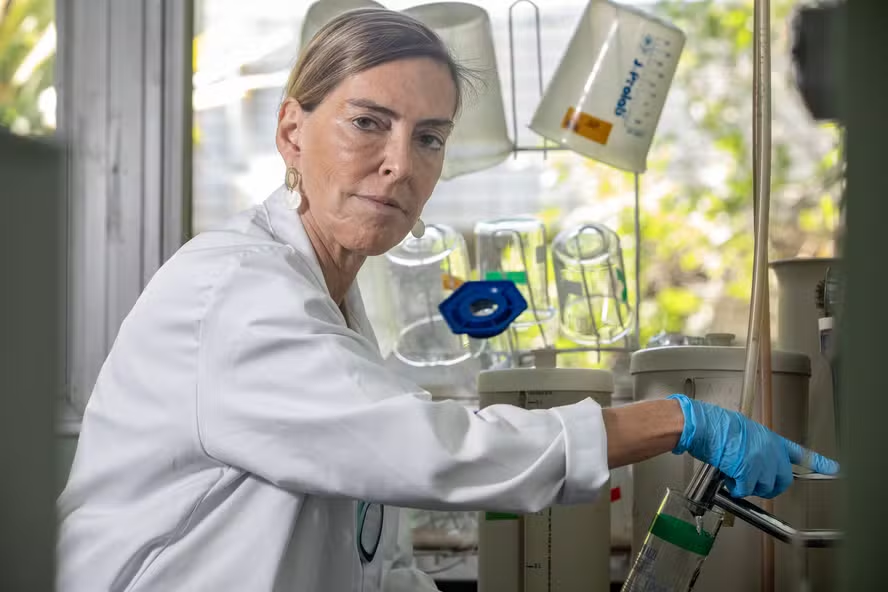
Dr. Tatiana Sampaio
UFRJ - Rio de Janeiro, Brazil
Tatiana Coelho de Sampaio is a biologist and researcher at UFRJ (Federal University of Rio de Janeiro). She holds a degree in Biological Sciences and completed both her master's and doctoral degrees at the same institution.
She undertook post-doctoral research at the University of Illinois (USA) and the University of Erlangen-Nuremberg (Germany). Since 1995, she has been a professor of Histology at UFRJ.
Over nearly three decades, she has dedicated herself to studying proteins in nervous tissue, particularly laminin -- a natural protein involved in neural regeneration. In her laboratory, she led the creation of polylaminin, a polymer of laminin designed to stimulate neuron regeneration in the spinal cord.
Education & Career
- BSc in Biological Sciences -- UFRJ
- MSc and PhD in Sciences -- UFRJ
- Post-doctoral -- University of Illinois, USA
- Post-doctoral -- University of Erlangen-Nuremberg, Germany
- Professor of Histology at UFRJ since 1995
Current Role
Head of the Extracellular Matrix Biology Laboratory at ICB/UFRJ, coordinating research on spinal cord injuries and co-author of a pioneering article (Frontiers, 2025) demonstrating promising effects of polylaminin.
What is Polylaminin?
Understanding the science behind this experimental treatment for spinal cord injuries.
A Biological Bridge
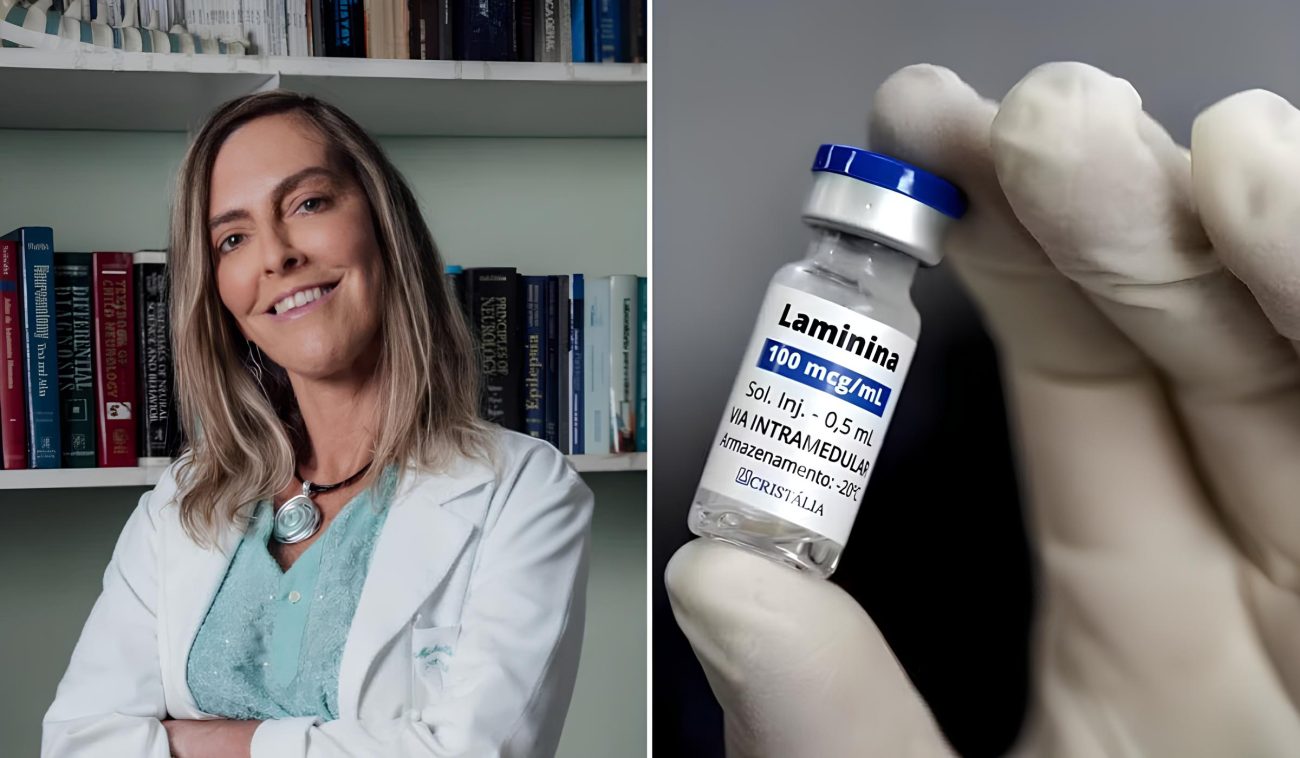
Polylaminin is a polymer derived from laminin, a protein extracted from human placenta. It can act as a biological bridge in spinal cord injuries. When injected into the damaged spinal cord, it fills the damaged space and forms a "bridge" that helps reconnect neurons above and below the injury, potentially restoring movement and sensation.
How It Works
Extraction
Laminin is extracted from human placenta and processed into a polymeric form in the laboratory.
Injection
A single surgical intra-medullary injection delivers the polymer directly to the injury site during spinal surgery.
Bridge Formation
The polymer creates a favorable substrate that helps surviving neurons reconnect across the damaged area.
Rehabilitation
Intensive physiotherapy follows to maximize muscular recovery. Best results are seen when administered within 24-72 hours after trauma.
Current Status
The current data is still preliminary: there are no completed clinical studies to prove efficacy and safety in humans. Dr. Sampaio emphasizes that, for now, it is a "promise of treatment" that will only be proven when there is definitive registration and regular use.
Preliminary Reports
There are reports of patients who showed partial recovery after receiving polylaminin through court orders. These cases are encouraging but await validation through more rigorous clinical studies.

Bruno Drummond
31 years old
Condition: Tetraplegic -- complete cervical injury in 2018, no movement below the shoulders.
About two weeks after receiving the polylaminin injection (followed by intensive physiotherapy), Bruno recovered movement in his feet and, over the following months, walked again. His case was considered a milestone in Brazilian motor rehabilitation.

Diogo Barros Brollo
35 years old
Condition: Paraplegic -- fall victim with complete spinal cord injury.
One month after application, he reported regaining sensation in parts of his legs and being able to voluntarily move his right foot and contract his thigh.
Luiz Fernando Mozer
37 years old
Condition: Paraplegic -- submitted to injection about two weeks before reporting.
The physiotherapy team recorded voluntary muscular contractions in the lower limb, considered "significant" progress for the rehabilitation stage.

Woman from Minas Gerais
35 years old
Condition: Severe injury after car accident.
After receiving polylaminin by court order, she began to feel touch sensitivity in her legs and can partially contract her thigh.
Scientists urge caution: samples are small, without control groups, and some patients could recover some function spontaneously (estimates suggest up to ~30% partial improvement after acute spinal cord injury without treatment). As Dr. Sampaio emphasizes: only when all treated people recover function will there be a revolution; until then, these are promising results, but not a proven "cure."
The Road Ahead
Polylaminin is still in its experimental phase. The next steps involve conducting rigorous clinical trials.
Phase 1 -- Safety
In January 2026, ANVISA authorized the first human study: 5 volunteers (18-72 years) with acute and complete thoracic spinal cord injury (less than 72 hours after trauma) will receive a single surgical injection. This initial test aims only to confirm that the substance does not cause serious adverse reactions.
Phase 2 & 3 -- Efficacy
Only after success in Phase 1 can controlled studies in larger groups be conducted to assess real benefit. Double-blind trials with placebo and controlled groups (the gold standard of medical research) are expected. This complete process may take several years until the drug is registered.
Pre-clinical Research
In parallel, Dr. Sampaio's team is investigating the use of polylaminin in animal models of chronic injuries. Studies with dogs, for example, are underway to assess whether the molecule can help with older injuries.
Dr. Sampaio estimates that, if regulatory stages proceed without setbacks, polylaminin could reach the market in 2 to 3 years. If approved, Cristalia laboratory plans to offer it through SUS (Brazil's public health system), making it available to paralyzed patients.
Social Impact
Families of paralyzed individuals see unprecedented hope in polylaminin. Dr. Sampaio reports receiving "desperate requests" for help and "incessant" calls from patients seeking treatment.
Due to the lack of registration, many patients have resorted to the courts to access the experimental medication. By February 2026, approximately ten court orders had been granted authorizing polylaminin injection.
Scientific authorities call for rigor. In a joint statement (SBPC/ABC, Feb 2026), leaders emphasized that any questions about polylaminin should be debated in appropriate technical forums, with peer review and formal clinical trials.
The discovery of polylaminin has earned approximately R$3 million in royalties for UFRJ (the largest amount ever paid by the university). The project counts on partnership with Cristalia laboratory and FAPERJ support.
Support This Research
Your contribution helps advance this groundbreaking research. Donate using cryptocurrency.
Bitcoin
BTC
bc1qqg7sg5snlgd9ppp0a0myw48uhrd9mhfttwwau0
All donations go directly toward supporting spinal cord injury research and the development of polylaminin treatment.
Contact Email
For questions, partnerships, or more information about the research, reach out via email.
[email protected]References & Sources
All information on this website is based on published scientific reports, journalistic interviews, and official press releases. Check the original sources below.
Tatiana Coelho de Sampaio: conheca a historia da criadora da polilaminina
saude.abril.com.br
Tatiana Sampaio: A Cientista por tras da Descoberta Que Pode Devolver Movimentos a Humanos
forbes.com.br
Polilaminina: O que e, como funciona e o que falta comprovar
www.poder360.com.br
Campo Grande realiza 1a cirurgia com polilaminina em 14 de janeiro
www.campograndenews.com.br
Paciente que recebeu polilaminina por ordem judicial relata emocao ao mexer o pe e a perna
www.cristalia.com.br
Quem e Tatiana Sampaio, pesquisadora que tenta curar paraplegia
www.gazetadopovo.com.br